
Trading Appliance Liveness for Home Electricity Consumption Privacy
Chathuranga Sampath Kalutharage, Brendon Fowley, Cason Brady, and Matthew Bradbury. Trading Appliance Liveness for Home Electricity Consumption Privacy. In Computer Security. ESORICS 2026 International Workshops. Rome, Italy, 14-18 September 2026. Springer Nature Switzerland.
[ bibtex] [ file] [ project]
With the deployment of smart meters high time resolution data about power consumption of users is available, leading to privacy threats including the ability to predict the appliances owned by homes. Much past work has investigated shaping the power consumption of a home by using batteries, renewables, flexible thermal loads and other techniques. However, changes in user behaviour are less well studied. So, in this work we set out to explore if users could trade-off their ability to use a device (i.e., its liveness) to obtain greater privacy.
Using the REFIT Smart Home Dataset we used linear programming to transform the dataset to speculate on potential energy consumption. The dataset was transformed multiple times to explore all the different combinations of liveness constraints of the appliances in a home.
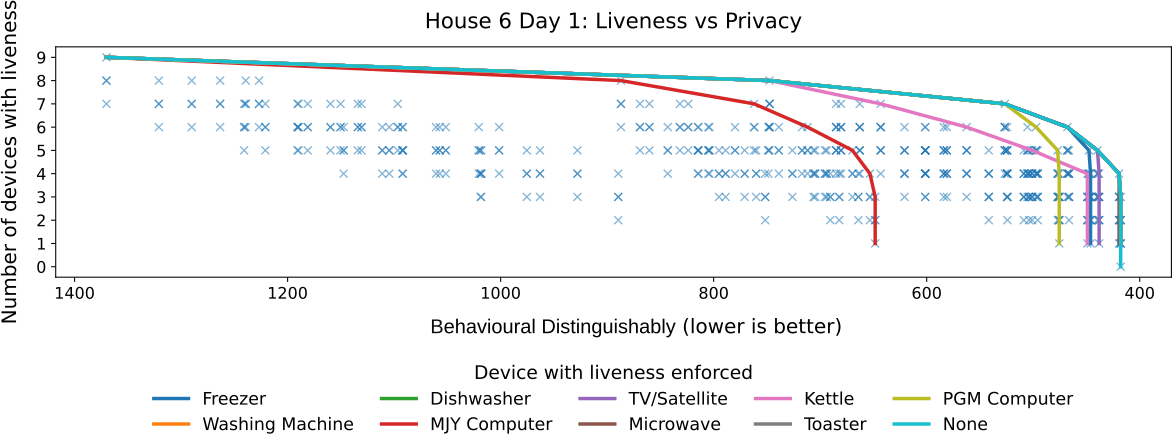
Our results showed that the energy consumption can be transformed to reduce the amount of information revealed to an adversary and that some appliances have a greater impact when users are willing to tolerate a loss of liveness to gain privacy.
Importance
Existing approaches have focused on techniques that require a monetary cost (batteries/renewables) or scheduling of appliances which are flexible in when they use power. This work considers the problem from a different approach, where user behaviour is changed. This gives users another dimension along which change can be made to improve privacy.
Perspectives
This work has investigated if users could trade-off appliance liveness to obtain greater privacy. In general, this is feasible with some appliances having a greater impact. However, what we have not investigated is users’ willingness to accept needing to not use an appliance at specific times in order to obtain this privacy gain. Such inconvenience may not be worth suffering to gain privacy, especially as batteries and renewables could be used instead where the trade-off is a financial cost instead of a cost to convenience. It would be useful for future works to explore whether users are willing to engage with behavioural change such as this to gain privacy.